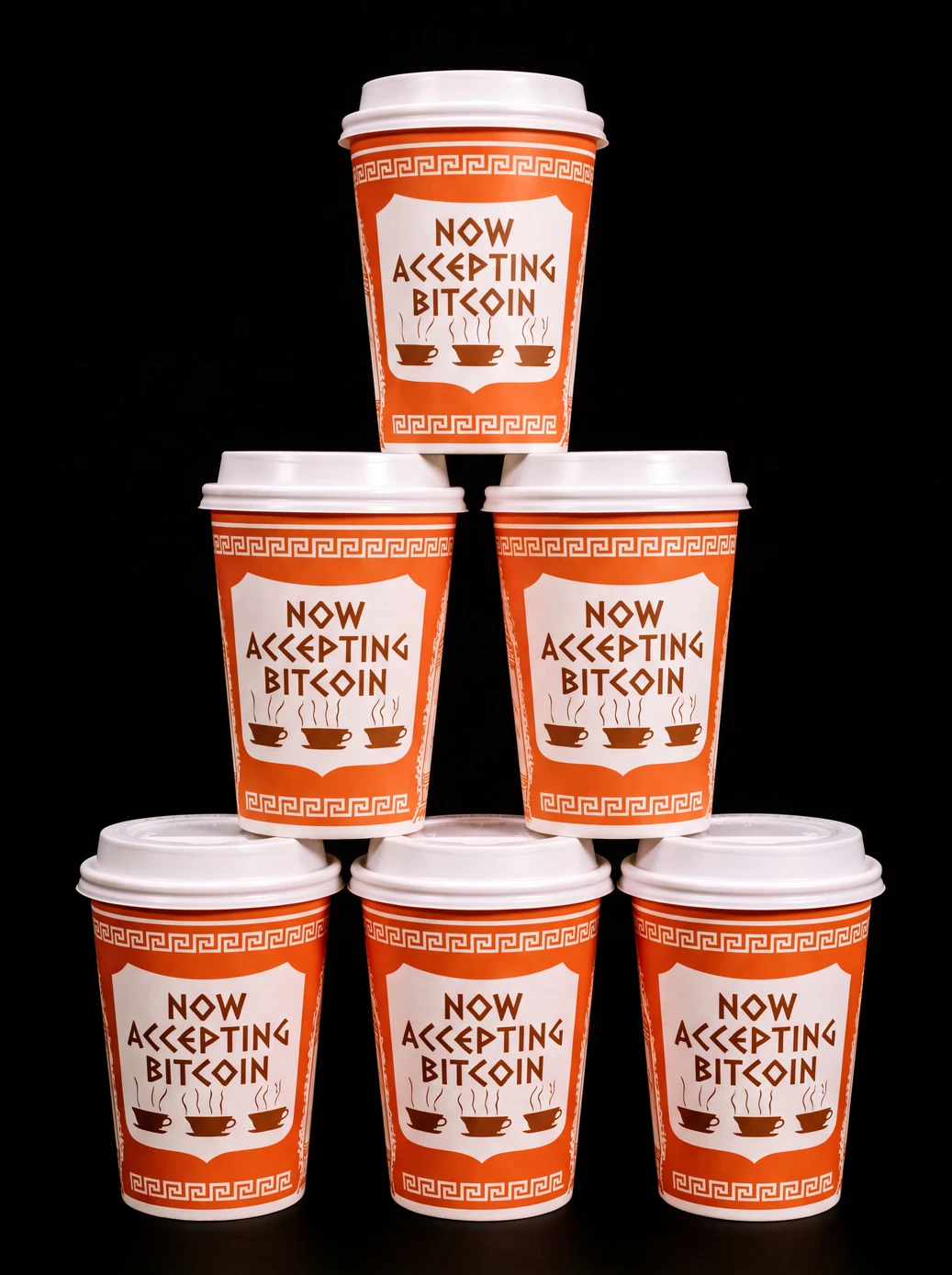
Does anyone actually
use bitcoin to pay for
a cup of coffee?
For years, the conversation around bitcoin payments has been largely theoretical. That is beginning to change. Block’s analysis of bitcoin payments through Square offers an early look at how consumers actually spend bitcoin in everyday life. Payment activity remains modest, and most purchases are relatively small, consistent with a new payment technology finding a place in everyday spending.
*Among Cash App customer-merchant pairs with at least two bitcoin payments. Figures rounded as in the report’s key findings.
Where People Spend
Early bitcoin payments
look remarkably
ordinary.
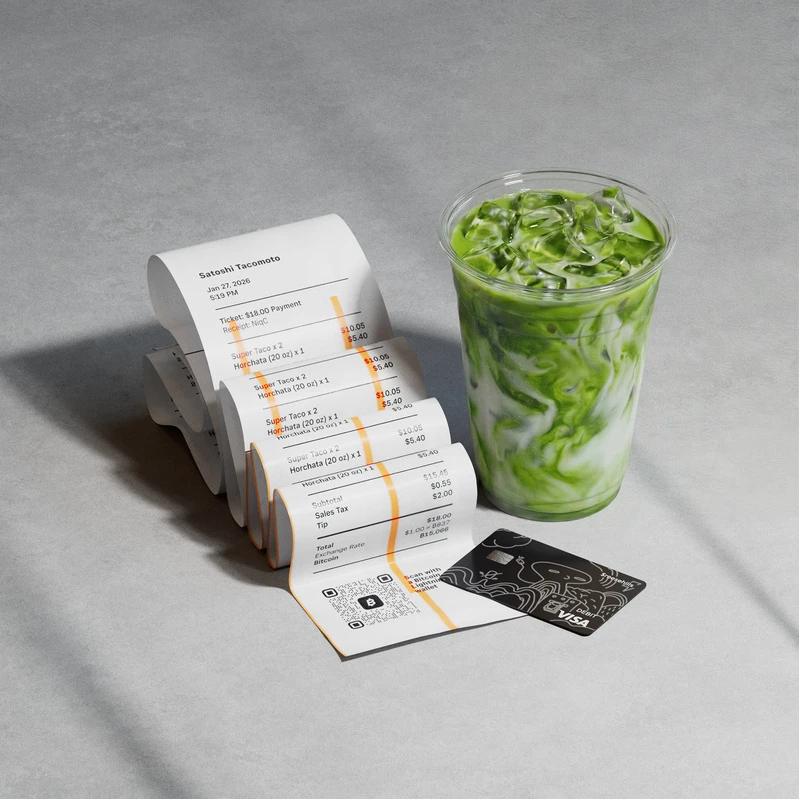
Food and drink businesses dominate, accounting for 72% of bitcoin payments through Square, with coffee shops, restaurants, bars, and food trucks driving much of the activity.
Median payment at
food & drink businesses
Share of payments by business category
0Share of payments →100%
Source: Square bitcoin and card payment data, Nov. 1, 2025–Oct. 15, 2026. Includes completed payments greater than $1. Card figures include all U.S. Square card payments.
A coffee.
A quick bite.
A grocery run.
Coffee shops and fast food businesses sit at the heart of bitcoin use, accounting for 62.6% of payments in the category. The $9.10 median payment suggests a classic coffee or quick-bite purchase. Grocery stores represent a smaller share of activity but have the highest average payment within the food and drink category, at $60.73 — consistent with a true grocery run rather than the purchase of a single, small item.
Payment Patterns
Small purchases.
Most payments.
Small purchases make up most bitcoin payments through Square, while a few larger purchases account for a substantial share of the dollars spent.
Nearly two-thirds of payments are under $20. Explore how the share of payments compares with the share of total payment value.
of payments
of total payment value
Thresholds are cumulative: Each includes payments below the smaller thresholds. Source: Square bitcoin payment data, Nov. 1, 2025–Oct. 15, 2026. Includes completed payments greater than $1.
View all payment thresholds
| Threshold | Payments | Total value |
|---|---|---|
| Under $10 | 42.4% | 7.9% |
| Under $20 | 65.1% | 19.1% |
| Under $50 | 89.0% | 43.4% |
| Under $100 | 95.8% | 59.2% |
| Under $200 | 98.1% | 69.5% |
And then,
they come back.
Among Cash App customers who made at least two bitcoin payments at the same merchant, the average number of purchases per customer-merchant pair was about five, with a median of three. Overall, 44% of bitcoin payments made by Cash App customers were repeat payments, and 86% of those occurred within 30 days. These patterns suggest routine consumer spending rather than isolated activity.
Time between consecutive payments
of payment intervals: 1–7 days
Median 3 days
Time between consecutive bitcoin payments by the same customer at the same merchant, among Cash App customer-merchant pairs with at least two payments. Source: Square bitcoin payment data matched to Cash App Lightning payment records, Nov. 1, 2025–Oct. 15, 2026. Includes completed payments greater than $1 where the payer could be identified (payments made from Cash App). Payments from other bitcoin wallets that can't be linked to a customer are excluded.
How People Pay
Beyond a
single app.
Merchants aren’t just serving customers already inside one ecosystem. They’re participating in a broader bitcoin economy.
Source: Square bitcoin payment data, Nov. 1, 2025–Oct. 15, 2026. Includes completed payments greater than $1.
External Lightning-enabled wallets, such as Strike, Wallet of Satoshi, Phoenix, and Coinbase, account for the remaining 57% of payments and 66% of payment value.
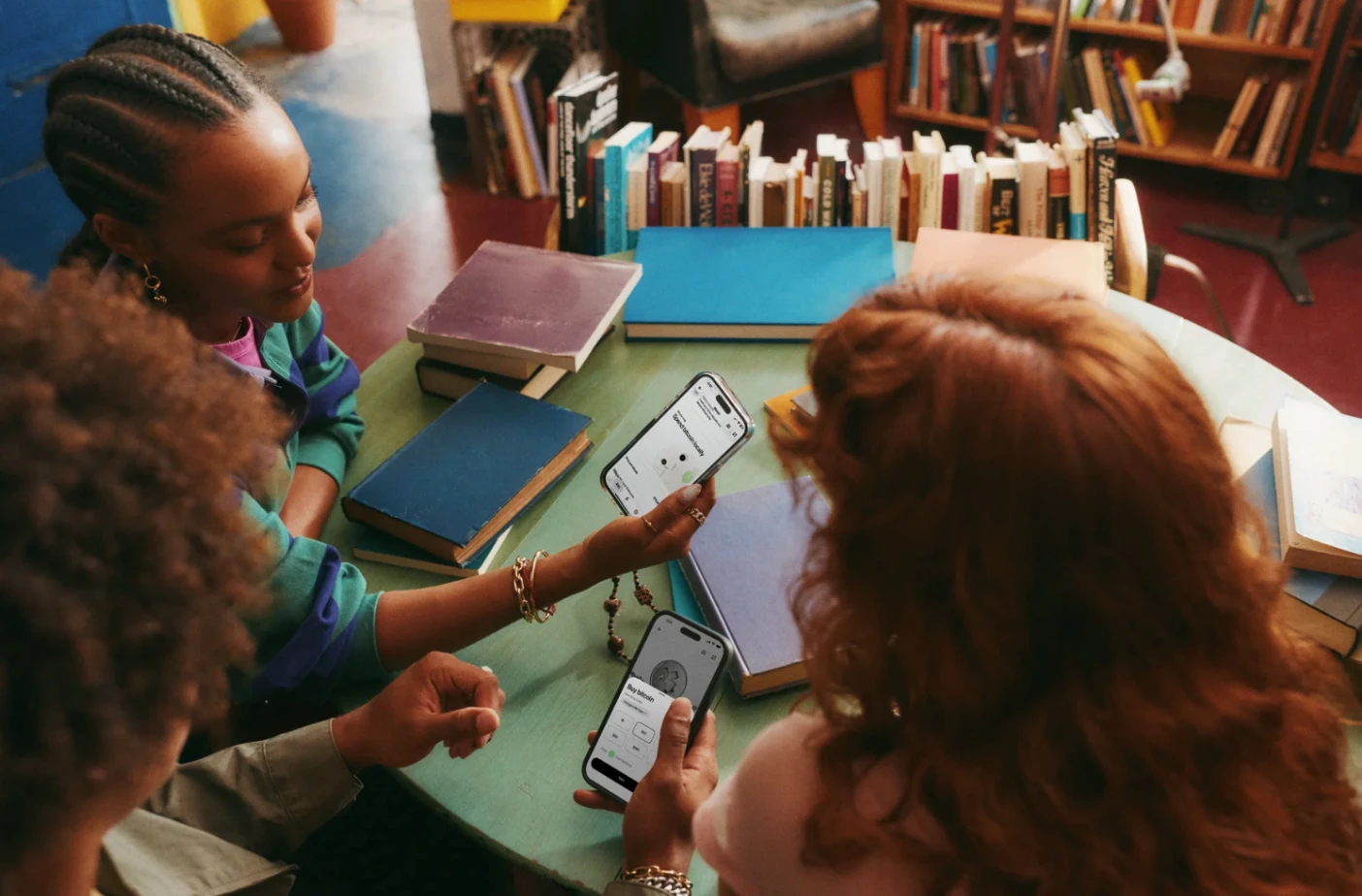
Bitcoin, U.S. dollars,
or both.
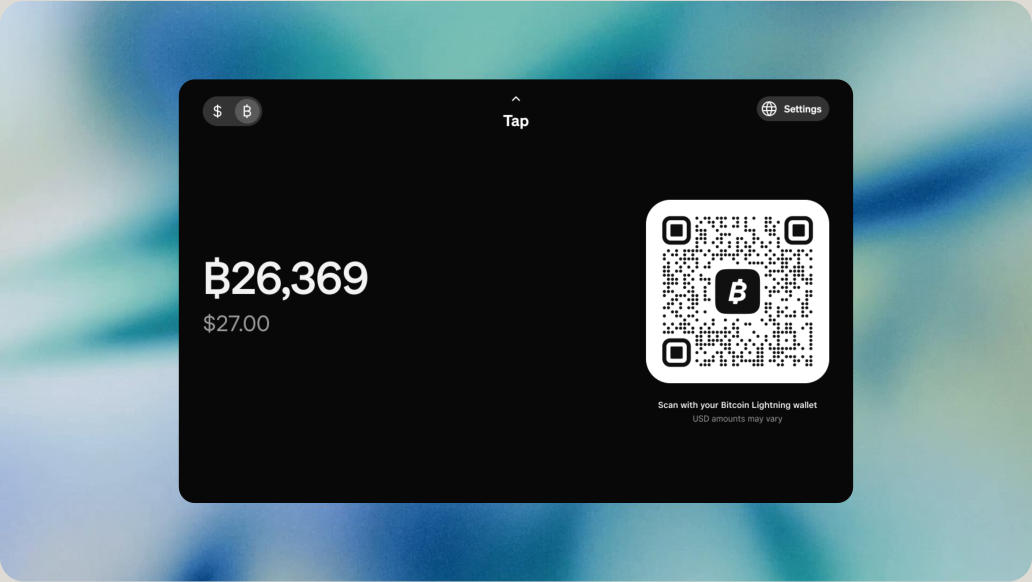
Merchants retain flexibility over how they receive the proceeds of a sale. Sellers can select what percentage of each sale they’d like to receive in bitcoin. For merchants who want to receive dollars, Square automatically converts the payment.
A merchant never has to miss a sale, and they get to enjoy a payment method with zero processing fees on Square*.
*Zero fee payment processing on Square has been extended through Dec. 31, 2027.
Policy Implications
Everyday payments.
Practical questions.
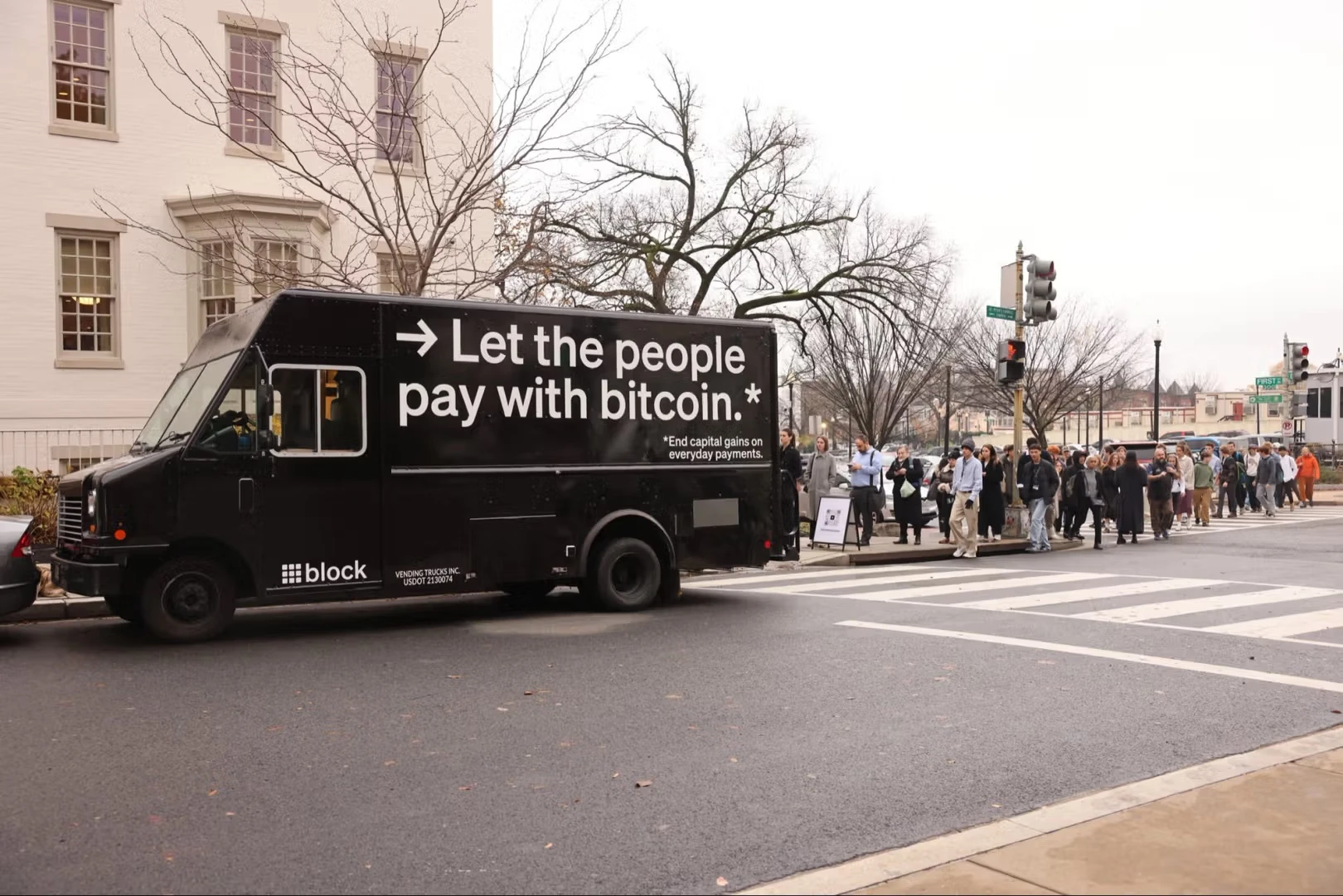
A small purchase can carry significant recordkeeping and tax reporting obligations long after the checkout line.
Under current U.S. federal tax rules, using digital assets to pay for goods or services generally requires consumers to determine capital gain or loss — even for routine purchases.
Nearly a quarter (23.6%) of businesses that don’t accept bitcoin as payment cite tax and accounting complexity as a reason why. That’s about the same amount as those who cite regulation, refunds, or price swings.
of businesses that have considered accepting bitcoin but haven’t yet cite tax and accounting complexity as a reason why.
of consumers who don’t own bitcoin say they’d be more likely to pay with it if it were easier. Among them, 15.7% say they’re unsure how it’s taxed or regulated.
Source: Morning Consult Bitcoin Brands Tracker, Wave 1, commissioned by Block. Survey population: bitcoin-aware U.S. adults. See methodology for business and consumer subgroup definitions.
Bitcoin has dual utility, as an investment and as a method of payment, both of which should be recognized in policymaking.
One approach under discussion is a de minimis exemption, a tax exemption for qualifying small gains realized when consumers use digital assets to make purchases. The data presented here can inform that discussion.
Behind the Report
Good policy begins
with understanding.
Our goal is to help inform public policy that recognizes both how people hold bitcoin and how they spend it.
Square payments data
Figures on bitcoin payments come from Block's records of completed bitcoin payments at U.S. Square sellers between Nov. 1, 2025 and Oct. 15, 2026. Known test payments and Block's internal sellers are excluded at source, and we also exclude every payment of $1 or less as a further guard against sellers testing the feature. Averages and medians are per payment. Business categories are the category currently recorded for each seller on Square, and food-and-drink business types use the seller’s merchant category code, so neither identifies the item bought. Amounts are the gross dollar value of each payment, with no refunds netted. The total number of Square bitcoin payments, the number of unique sellers receiving those payments, and total bitcoin gross payment volume (GPV) are proprietary business metrics and are not disclosed in this report.
Square card payments data
Card payment figures come from Block’s records of completed card payments at U.S. Square sellers between Nov. 1, 2025 and Oct. 15, 2026. They cover all card brands, both in person and online, and are not sampled. As with the bitcoin data, every payment of $1 or less is excluded. Averages and medians are per payment, and amounts are the gross value of each payment, including tax and tip, with no refunds netted. Business categories come from each payment’s merchant category code and are grouped to match the categories used for Square bitcoin payments. Neither identifies the item bought. Total card payment counts and volume are proprietary and are not disclosed in this report.
Survey data
Survey figures come from the Morning Consult Bitcoin Brands Tracker, Wave 1, commissioned by Block. Morning Consult surveyed 8,669 U.S. adults who are aware of bitcoin in an online survey from Aug. 13-21, 2026, and weighted the results; the margin of error on the full sample is 1.1 points. Because only bitcoin-aware adults took part, shares describe that group and do not extend to all U.S. adults. Business findings come from the 1,415 respondents who own a business or influence how a business they work for accepts payments, and the 1,047 of them whose business does not accept bitcoin or who are unsure. Findings on why people don’t own bitcoin come from the 7,692 respondents who do not own it today. Differences described in the text are significant at 95% confidence, tested on sample sizes adjusted for weighting.
Square bitcoin is not available to New York residents. Bitcoin is a non-deposit, non-bank product that is not FDIC insured and involves risk, including monetary loss. Bitcoin services provided by Block, Inc. are not licensable activity in all U.S. states and territories. Availability may be subject to regulatory approval, where applicable, and may change. Block, Inc. operates in New York as Block of Delaware and is licensed to engage in virtual currency business activity by the New York State Department of Financial Services. See disclosures and licenses.