How financial institutions and law enforcement can learn from each other
At Block, protecting customers includes understanding how criminals misuse financial services and working with others to help stop them. Financial institutions and law enforcement bring different perspectives to that work. Investigators may hear directly from victims or identify an emerging scam, while financial crime teams can help uncover connections in financial activity.
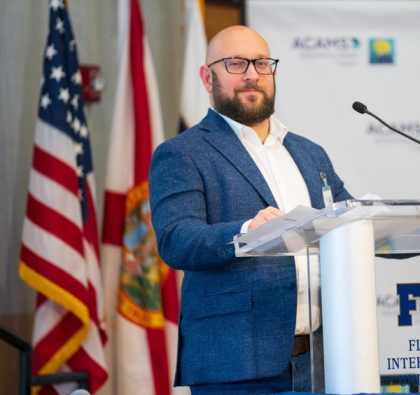
Alek Dvoskin, Head of Financial Crime Intelligence Program at Block, brings his experience at the Federal Bureau of Investigation and in financial services to Block’s work with law enforcement. We spoke with Alek about what drew him to financial crime intelligence, how his team educates and learns from law enforcement, and why collaboration and customer privacy must go together.
What drew you to financial crime intelligence, and what brought you to Block?
I started my intelligence career with the FBI in 2008. I held different positions, including Special Operations Specialist, Intelligence Analyst, and Supervisory Intelligence Analyst. Through that work, I saw how financial intelligence could advance investigations. It can help you connect people and activity that might otherwise look unrelated, and give investigators a clearer picture of what’s happening. That’s what drew me to this work: taking different pieces of information and figuring out what they mean together. You’re trying to understand how someone is operating, who they’re targeting, and where there may be an opportunity to intervene and stop the harm.
What drew me to Block was the chance to build a team that could bring intelligence and investigations closer together to help protect our customers. What we learn from an investigation can inform how we look for potential criminal activity, and what we identify through intelligence analysis can help guide the next investigation. Being able to build those connections, to work with incredible investigators and analysts, all in service of protecting customers around the world was a compelling opportunity.
What does your team do in practice?
The mission of the Intelligence Program is to serve as Block's central intelligence function for financial crime by identifying, analyzing, and mitigating threats while providing actionable intelligence that enables informed decision-making across Block businesses
The Intelligence Analysis Unit is built out of unbelievably talented intelligence analysts who help us make sense of information coming into our program. What does this information tell us? How does it connect to what we already know? Who needs to take a closer look? That team helps assess what we’re seeing and get it to the right people. Our Special Investigations Unit that focuses on complex, high-risk cases involving potential misuse of Block products including incidents of potential money laundering, fraud, terrorist financing, elder abuse, commercial human exploitation, misconduct investigations and other typologies. That means looking beyond an individual piece of activity to understand how it might fit into something larger.
The connection between those teams is really important. An investigation can raise new questions for our analysts, and analysis can uncover connections that warrant further investigation. The goal is to turn what we’re learning into something our teams can act on to help protect customers.
What can law enforcement help Block see that we might not see on our own?
We each see different parts of the picture. A victim may report a crime to law enforcement impacting them at a different financial institution, before we hear about it, or investigators may be looking into a criminal group and learning how it operates across different services. That context can help us proactively look for this activity. For example, knowing more about how a scam works can give us a better sense of what to look for. How are people being approached? What are they being asked to do? That context helps us investigate potential illicit activity and improve our internal controls.
And it goes both ways. We can contribute a financial perspective to an investigation, and what investigators learn can help us strengthen our protections. Neither side necessarily has the whole picture on its own. Being able to learn from each other, through the appropriate legal channels, helps us ask better questions and respond to potential threats. It is a two-way relationship.
What does a training session with law enforcement look like?
We offer both in-person and virtual training to local, state, and federal agencies. We help investigators understand our products, how our investigative teams work, and what support may be available. We explain how the products they may encounter in an investigation work, the type of data we have, and what information may be relevant. We want those sessions to be practical. An investigator may be familiar with a product as a customer, but looking at it in the context of an investigation brings a different set of questions. Training gives us a chance to work through those questions and help them understand where to go when they need assistance.
After training, investigators often follow up with questions about new cases or emerging patterns they are seeing. Those conversations can lead to a closer look at suspected criminal typology and a better understanding of how it may connect to a broader network. So while we’re there to explain our products and processes, we’re also learning from what investigators are encountering in their work.
How do you approach collaboration while protecting customer privacy?
Protecting customers includes protecting their privacy. That responsibility is part of how we approach our work with law enforcement, and it’s why having clear processes for exchanging information is so important. Building a relationship with an investigator or providing training doesn’t change those requirements. Requests for customer information still need to go through the applicable legal process. There’s also a lot we can help investigators understand about our products and how to contact us without discussing any individual customer’s information. Those conversations help agencies understand what support may be available and how to request it appropriately.
How do you know this work is making a difference?
We hear directly from agencies when our support has helped advance an investigation. Sometimes information our teams identify and report through lawful channels turns out to be relevant to a significant case an agency is already working on. That is why public-private partnerships are so important. Whether we are dealing with scams or other organized criminal activity, we are better positioned to respond when we bring our different perspectives together. We share a common goal with law enforcement to help stop the people causing harm and protect the people they target.