Turning what we learn into how we protect
Investigating financial crime can reveal how criminals operate, who they target and where protections need to improve. At Block, our teams use what they learn from investigations and work with external partners to help colleagues across the company recognize risks and act on them.
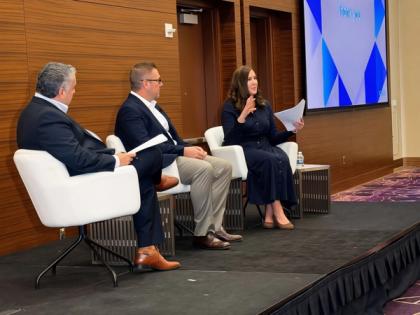
Megan Gonzales, Global Head of Compliance External Engagements & Intelligence at Block, brings nearly two decades of experience across law enforcement and financial services to that work. We spoke with Megan about how her team’s investigations and external partnerships inform customer protections, how technology is changing financial crime, and what makes the work meaningful to her.
What shaped the way you think about protecting people who use financial services?
My work has spanned anti-money laundering, counter-terrorist financing, customer identity verification, sanctions compliance, and financial crime detection and intelligence. Across investigations and partnerships with law enforcement, I’ve seen that a suspicious transaction can be connected to a person experiencing real harm. What makes the work meaningful to me is knowing there’s a person behind what we’re investigating, and that we may be able to help. Internal controls and protecting our platforms matter, but we’re also thinking about the people using our products every day. We want financial services to be accessible and safer for them.
At Block, that work has included building our anti-human exploitation program and creating opportunities for law enforcement to learn about our products. Bringing that experience into a company where it can inform customer protections is an important part of what I do.
What does your team do behind the scenes?
I lead two programs at Block, Anti-Human Exploitation and Intelligence. Anti-Human Exploitation owns Compliance’s policies and governance for child safety and human exploitation prevention. Intelligence drives financial crime intelligence, complex investigations, and law enforcement collaboration. My team helps Block understand how criminals misuse financial services and turn that understanding into action. Sometimes that means strengthening a safeguard, reviewing a product decision, or helping customers recognize a risk. For someone using our products, much of that work is behind the scenes. Our teams are looking for harmful activity, supporting investigations, and using what they learn to strengthen protections across the company.
Who do you work with outside Block, and what do those relationships make possible?
We work with law enforcement, regulators, other financial institutions, child protection organizations, and industry groups. Each brings a different perspective. Through lawful channels we may see transactions, while another organization may have victim reports, information about a criminal network, or a view of activity across several platforms. The most useful conversations help us connect those perspectives and come away with something we can act on which can be a warning sign, an investigative lead, or a better way to respond.
It’s important to maintain those relationships as criminal activity changes. We want to understand more than what is happening on our own platforms. We want to understand how it fits into a larger problem.
How do your conversations with external partners help inform customer protection?
I participate in working groups and roundtables in the U.S. and internationally where people discuss how policy and regulation work in practice. Our team can bring a perspective grounded in what we’re seeing in investigations and how criminals are misusing financial services.
Information-sharing is one example. A scam can move across several platforms, and financial institutions may encounter different parts of the same activity. Working together through lawful channels can help us understand those connections. But it’s important to be clear about what information can be shared and how customer privacy is protected.
Scams can also begin outside financial services, such as on a social platform, before a payment is involved. Those conversations help us explain where the challenges are and where policies and industry practices may need to evolve as crime changes.
How do you recognize when a risk emerging in one market could become a concern elsewhere?
I look at the behavior behind a scheme, rather than treating it as something unique to one country. What allowed it to work? If it involves money moving across several services, could similar conditions exist in another market or across other Block products?
The exact scheme may look different, but understanding those conditions helps us assess whether a risk could be relevant elsewhere. We also look beyond activity already affecting Block. Learning about a threat in another market gives us an opportunity to consider our exposure before we encounter it ourselves.
The important part is translating that information into decisions. What does it mean for a team’s safeguards? Should it inform how a product works or how we educate customers? Intelligence is useful when it helps people understand a risk and decide how to respond.
How is technology changing financial crime, and what does that mean for how we protect customers?
Criminals are some of the best adopters of technology. I sometimes compare it to pickpocketing. Someone once had to be physically near you to steal from you that way. Now someone thousands of miles away can cause financial harm while targeting multiple people at once.
That changes the scale and pace of the response we need. Financial companies also need to use technology, including AI, responsibly to identify harmful activity and introduce safeguards at the right moments. Technology can help us detect and respond to potential harm, but timeliness matters too. It’s not enough to understand a threat eventually. We need to keep improving how we recognize it and act.
What tells you the work is making a difference, and what keeps you motivated?
I look for evidence that something changed in what we can see or do. Did an investigation advance? Did intelligence inform a customer safeguard? Can we recognize and respond to a threat sooner? We’ve seen our reporting and law enforcement partnerships contribute to arrests and victim identification. Knowing that our financial intelligence helped law enforcement is deeply meaningful. I also value being able to share those outcomes with the investigators who did the work. They don’t always get to see what happens afterward, and that feedback helps connect their day-to-day efforts to the people they may have helped.
We bring what we learn back into our own protections. Criminals change how they operate, so we have to keep evaluating and strengthening our response. This has been a significant focus for Block, and we will continue investing in external relationships and learning from investigations. My team is one part of that effort. It takes people across the company working together to make those insights useful and help protect our customers.